
Hi everyone, I’m Leonardo, and I want to welcome you to this inaugural post.
For quite some time, I had been searching for a space game capable of truly satisfying me. I had specific features in mind: a galaxy packed with systems to explore, genuinely dynamic trade, and deep political mechanics. Failing to find anything that matched this vision, I began to imagine The Ledger Syndicate. After months of paper sketches, notes, and sleepless nights, I officially started development in August 2025.
By November of that same year, the project caught the attention of a major publisher, Slitherine. We organized video conferences, but unfortunately communication broke off abruptly before the final steps could be taken. Rather than letting this discourage me, the silence gave me the final push I needed: I decided to keep going and to build this project out in the open. I firmly believe that the work done so far and all the “behind the scenes” efforts should not go to waste. I am confident that, together, we are going to see some amazing things.
The project philosophy
Before diving into the technical details, I want to make a small point. It is said that Leonardo da Vinci never truly completed the “Mona Lisa,” continuing to add tiny details for years in search of an unattainable perfection. My vision for this project is equally ambitious (with all due respect to the master!). Although the current state of the game might already seem advanced to some, my goal is to keep refining it, adding content, and expanding it until it exactly mirrors the concept I have in my head.
This does not mean you will have to wait a decade: my target is to release a stable version on Steam in late 2028. But this is where you come in: your support and feedback along the way will be crucial to help me bridge the gap in my artistic skills and significantly speed up development.
Welcome aboard.
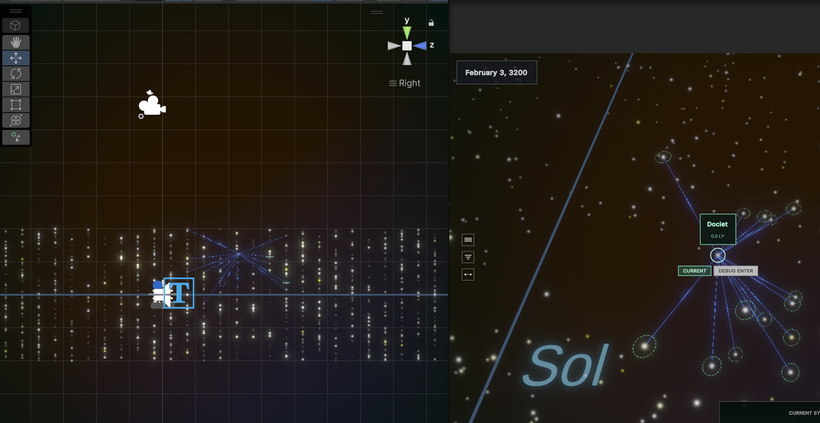
All the screenshots in this post are work in progress and serve only as placeholders. The content shown does not reflect the look of the final product.
The genesis of the galaxy: from chaos to order
The first step in this journey was creating the “container” for everything: the Galaxy. My goal was to make the player feel infinitely small in the face of the cosmos’ vastness. To achieve this, I chose a procedural and deterministic generation method. Our galaxy will host thousands of star systems, and within them we will find planets, moons, and stations, all created by math.
Here is how the “engine” of The Ledger Syndicate universe works:
1. The “DNA” of the universe (the seed)
It all starts with a number, called the Seed. It’s like the galaxy’s genetic code. If you use the same number, you get exactly the same universe, star by star. This allows us to generate billions of different galaxies just by changing a single digit, while keeping consistency for players sharing the same Seed.
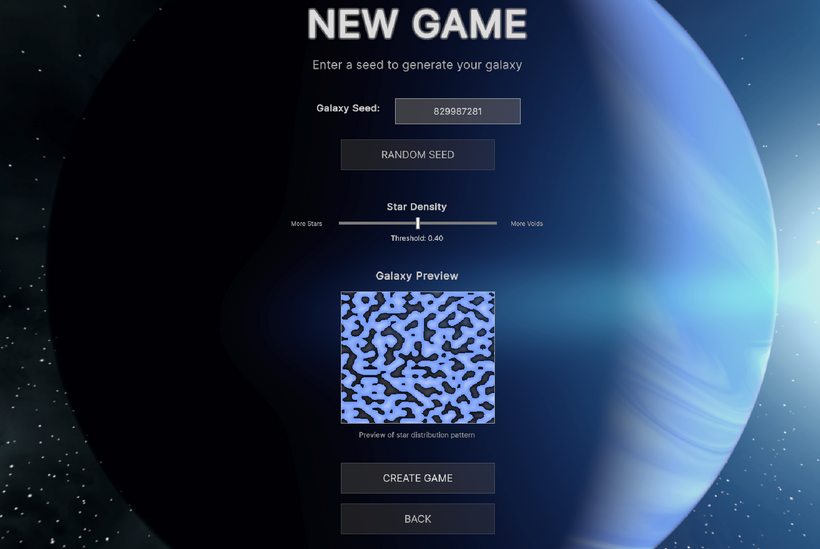
2. The shape: throwing sand in the dark
To decide where stars are born, we use density-based algorithms. Imagine throwing a handful of sand onto a black sheet of paper:
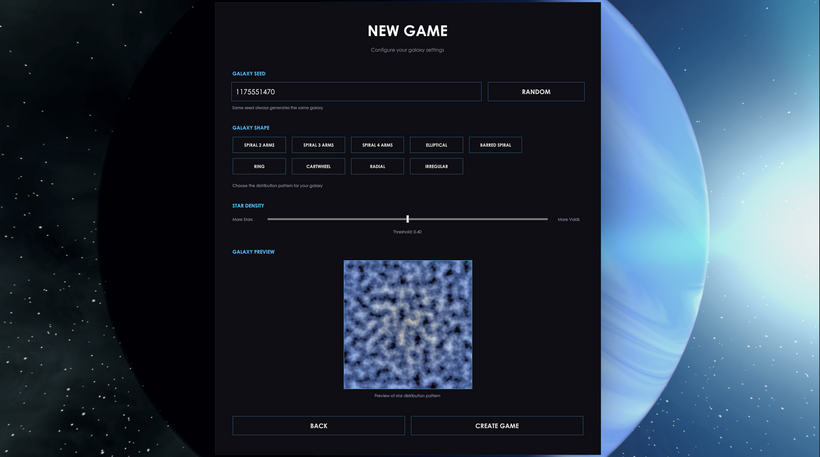
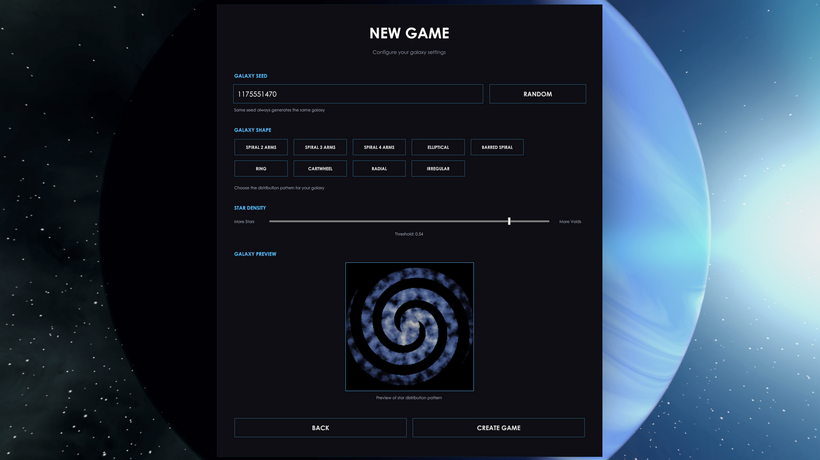
- I use mathematical curves to define the general structure (e.g. a spiral with arms).
- The probability of a star appearing depends on the density of that area in the formula: the closer you get to the center or inside a spiral arm, the more crowded the sky becomes.
3. The touch of realism: Perlin noise
If we only used perfect geometric formulas, the galaxy would look artificial. This is where Perlin noise comes in. It’s an algorithm that creates random but “smooth” variations, similar to how clouds or hills form in nature. I use it to break the perfection:
- Variation: creating empty zones or unexpected clusters.
- Color: deciding where to place nebulae and interstellar dust.
- Resources: distributing minerals, making some sectors rich and others poor to stimulate natural trade routes.
4. Stellar logic
Once a star is placed, the system decides its type (Red Dwarf, Blue Giant, Sun-like) and generates planets around it following logical rules. You will never find an ice planet right next to a scorching star!
In short: we use mathematics to create the “organized chaos” that makes space such a fascinating place to explore.
In upcoming posts, I will dive into the economy system and entities. I’ll also share more screenshots and gameplay videos. Your feedback is crucial for development. Thanks for reading.
See you soon, Leonardo D’Incalci.